Optimize Ad Spend and Feed ROI, Not the Algorithm
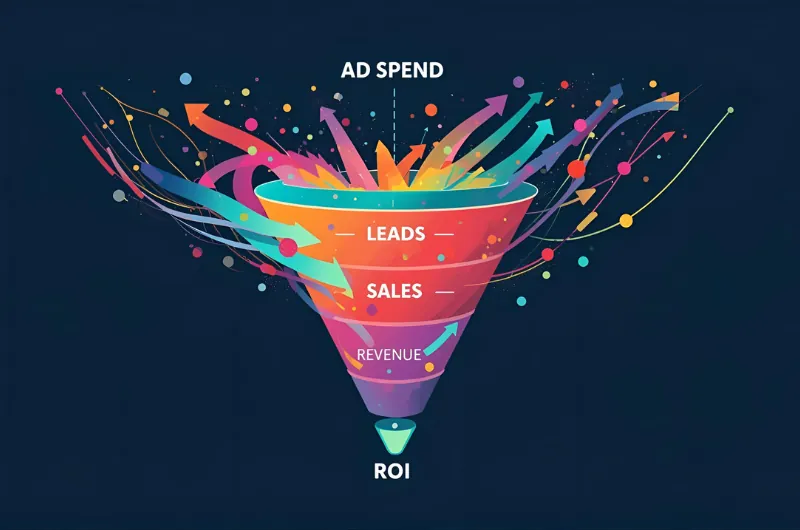
Most businesses waste thousands each year on ads that never convert. “Set it and forget it” campaigns, broad targeting, and weak tracking drain budgets quickly.
In this guide, you’ll learn how to optimize ad spend by focusing on the levers that matter: tracking, account structure, bidding, audiences, and creative. We’ll also show you real-world examples of how small adjustments can unlock big savings.
To put it simply, optimizing ad spend means reducing wasted impressions and clicks while improving return on ad spend (ROAS).
Why your ad spend is feeding the algorithm
Ad platforms are designed to maximize their revenue, not yours. Left on default settings, your campaigns often over-rely on broad match types, automatic placements, and loose audience definitions. The result? More clicks, but fewer conversions.
Weak tracking makes things worse. If you aren’t measuring calls, forms, or offline conversions, the algorithm optimizes for the wrong signals. Creative fatigue also sneaks in, running the same ad set for months leads to higher costs and lower click-through rates.
If you’re here, it’s because you want to stop this cycle and learn how to fix it. Let’s break it down.
The 5-point framework to optimize ad spend

There are five core levers every advertiser should address:
- Track what matters first
- Clean account structure & keywords
- Smart bidding & budget pacing
- Audience strategy & exclusions
- Creative + landing pages that convert
1) Track what matters first (before touching bids)
Optimizing bids without proper tracking is like flying blind. Start here:
- Define primary conversion actions (form fills, calls, purchases).
- Deduplicate events across Google Ads and GA4.
- Import offline conversions when possible.
- Use call tracking numbers for phone-heavy businesses.
- Maintain UTM hygiene for campaign attribution.
Quick checklist:
- Verify GA4 conversion events
- Set ROAS or CPA targets in advance
- Test all forms and call tracking
2) Clean account structure & keywords
Messy structures cause wasted spend. Instead:
- Use consolidated campaigns and tightly themed ad groups.
- Apply match types intentionally, exact for control, phrase for reach.
- Add negative keywords regularly to cut junk queries.
- Review search terms weekly (“query mining”).
A simple example: One service business cut wasted clicks by 22% in a month after excluding competitor names and DIY-intent keywords with negative lists.
Remember: higher Quality Score improves ad rank and reduces cost-per-click (CPC).
3) Smart bidding & budget pacing
Once tracking and structure are clean, layer in bidding strategies.
- Max Conversions: for new campaigns with solid conversion tracking.
- Target CPA (tCPA): when you know your ideal cost per acquisition.
- Target ROAS (tROAS): for e-commerce with revenue data.
Avoid “limited by budget” traps by pacing spend.
Weekly budget pacing routine:
- Check spend vs. budget allocation every Monday.
- Adjust bids or caps to align with weekly pacing.
- Use dayparting if performance varies by hour/day.
- Revisit campaign caps on Fridays to prevent overspend.
4) Audience strategy & exclusions
The right audience strategy saves money:
- Layer in-market, custom intent, and remarketing segments.
- Cap frequency to prevent ad fatigue.
- Exclude recent converters and poor-fit geos.
For example, adding layered audiences (retargeting + in-market) improved one client’s CPA by 28% within six weeks.
5) Creative + landing pages that convert
Even the best targeting fails if the ad and page don’t align.
- Rotate fresh creatives every 4–6 weeks.
- Match ad copy to landing page headlines.
- Ensure above-the-fold clarity with one clear CTA.
- Improve page speed and reduce form friction.
- Add trust elements: testimonials, badges, guarantees.
A/B testing roadmap:
- Start with headlines
- Move to offers/value props
- Then test social proof placement
“Every wasted click is an opportunity cost, optimize the page, not just the ad.”
Real-time optimization beats “set it and forget it”
Optimization isn’t monthly reporting, it’s daily and weekly adjustments.
Weekly focus: check budgets, negatives, and audience overlap.
Daily focus: pause underperforming ads, rotate creatives, monitor pacing.
This is the foundation of our digital advertising services. Real-time optimization ensures you stop feeding the algorithm and start feeding your pipeline.
Examples & mini case studies
General Contractor (Google Ads + LSA):
- Situation: $3,500/mo spend, broad match chaos, no negatives.
- Actions: Added negatives, shifted to tCPA, implemented call tracking, cleaned LSA profile.
- Result: CPA ↓35% in 60 days; qualified calls ↑48%.
Physical Therapy (Search + Performance Max):
- Situation: Creative fatigue, no audience signals, slow site speed.
- Actions: Improved product feed, added audience signals, launched fresh creatives, fixed site speed.
- Result: ROAS ↑29%, non-brand CPC ↓18%, revenue ↑22% QoQ.
What to do this week (checklist)
- Add 10+ negative keywords from recent search terms.
- Audit GA4 conversions and remove duplicates.
- Review budget pacing and adjust caps.
- Refresh at least one creative asset.
- Run a landing page speed test and fix issues.
- Check remarketing lists and exclude recent converters.
- Clean up UTM tracking.
- Block 30 minutes each week for optimization.
Want a second set of eyes? Our data-driven ad campaign management with real-time optimization for Google Ads can help you cut waste without guesswork. Get a Free Strategy Call
FAQs
How long does ad spend optimization take?
Most accounts see improvements within 30–60 days, depending on data volume and changes implemented.
Is lowering CPA always the goal, or should I chase ROAS?
It depends. Service businesses often prioritize cost per acquisition (CPA), while e-commerce should focus on return on ad spend (ROAS).
How do I know if it’s my bids or my funnel?
If conversion rates are low, fix your landing pages and funnel. If conversion rates are solid but costs are high, adjust bids and budget pacing.
From wasted spend to working dollars
Optimizing ad spend isn’t about chasing hacks, it’s about disciplined, repeatable adjustments across tracking, structure, bidding, audiences, and creative.
If you’re ready to move from theory to execution, let’s talk. Schedule a no-pressure strategy call, and we’ll walk you through how real-time Google Ads optimization can reduce wasted spend and improve your bottom line.
Keep reading
How PPC Competitor Analysis Helps you Stop Competitors from Stealing Clicks
Section Breakdown When Visibility Slips, So Does Opportunity If your competitors seem to always appear before you in Google Ads, it’s not luck, it’s strategy. Falling behind in digital visibility…
5 Best Digital Advertising Strategies to Turn Luck into ROI
Running ads shouldn’t feel like gambling. Discover five digital advertising strategies to replace guesswork with structure and turn clicks into predictable ROI.