Digital Advertising Guide: For ROI and Long-Term Growth

Digital advertising is no longer optional for growth-focused businesses. It is the most measurable, controllable, and scalable form of marketing available today.
But most businesses misunderstand how it works. They focus on traffic, impressions, or clicks instead of performance and revenue.
This guide explains digital advertising clearly and practically. You will understand how it works, how to measure it, and how to use it for sustainable growth.
What Is Digital Advertising?
Digital advertising is the practice of promoting products or services through paid placements on digital platforms. These platforms include search engines, social media, websites, apps, and streaming services.
Unlike traditional advertising, digital ads can be targeted, measured, and optimized in real time. You can adjust budgets, audiences, creative, and bidding strategies while campaigns are running.
The true advantage of digital advertising is control. You can test variables quickly and scale what works. That is why performance-driven businesses prioritize it.
The Core Types of Digital Advertising

Understanding channel differences helps you align strategy with goals. Each type serves a different stage of the buyer journey.
1. Search Advertising (PPC)
Search ads appear when users actively search for solutions. This makes them high-intent and conversion-focused.
You bid on keywords, compete in auctions, and pay per click. Performance depends on targeting accuracy, ad relevance, and landing page experience.
If your campaigns are generating traffic but not results, the issue is often deeper than ad copy. Many businesses struggle with clicks that never convert because the funnel is broken.
2. Display Advertising
Display ads appear across websites and apps. They are visual and often used for awareness, retargeting, and brand reinforcement.
Performance depends on creative clarity and audience targeting. Weak messaging often leads to wasted impressions and budget leakage.
3. Social Media Advertising
Social platforms allow demographic, behavioral, and interest-based targeting. This makes them powerful for both prospecting and retargeting.
However, targeting precision alone does not guarantee ROI. Without strategic structure, even strong platforms can produce inconsistent results.
4. Video Advertising
Video ads run on platforms like YouTube and streaming services. They are effective for awareness and consideration.
Measurement must go beyond views. Completion rates, engagement, and assisted conversions matter more than vanity metrics.
Platform tools alone do not guarantee ROI. Sustainable performance requires proven digital advertising strategies that drive ROI, not random boosts or reactive spending.
How Digital Advertising Actually Works

Digital advertising operates through auctions and targeting systems. Platforms evaluate bids, quality signals, and expected engagement to determine placements.
You typically pay using models such as:
- CPC (cost per click)
- CPM (cost per thousand impressions)
- CPA (cost per acquisition)
Performance improves when targeting, creative, and landing experience align. If one component fails, the entire system underperforms.
Many businesses unknowingly drain their budget because of structural inefficiencies inside campaigns. Fixing those hidden cost drivers often unlocks immediate improvement.
Targeting: The Engine Behind Performance
Targeting determines who sees your ads. Platforms allow segmentation based on demographics, interests, behaviors, location, and remarketing lists.
High performance comes from audience clarity, not guesswork. Businesses that skip research often overspend and underperform.
Competitor analysis also plays a role. Understanding how others bid, message, and position themselves can prevent lost clicks and wasted spend.
Without competitive insight, you risk paying premium prices for traffic that converts poorly.
The Metrics That Actually Matter

Digital advertising produces large volumes of data. Not all of it is useful.
Focus on metrics that tie to business outcomes:
- Conversion rate
- Cost per acquisition
- Return on ad spend (ROAS)
- Customer lifetime value
CTR and impressions provide context, but they are not success indicators alone.
If leads are not turning into customers, the issue may sit beyond the ad platform. Many businesses discover that the real conversion problem lies inside their sales process.
The Conversion Funnel
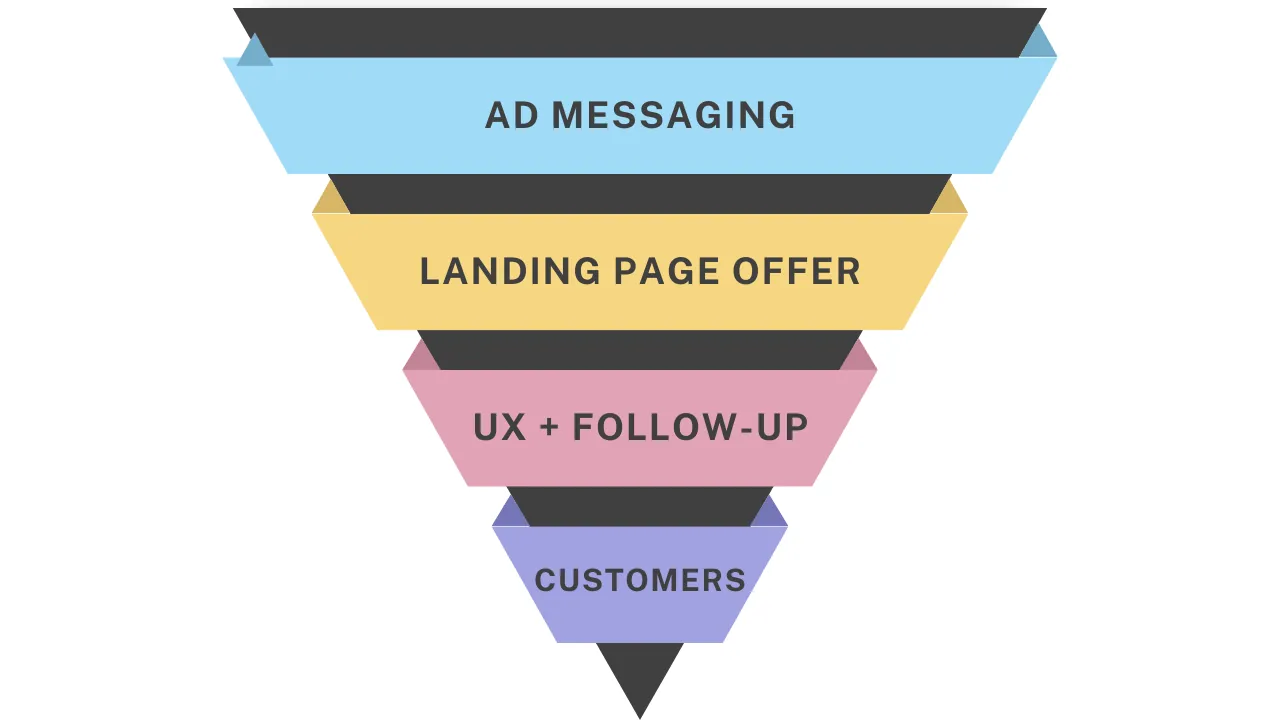
Traffic does not equal revenue. Conversions happen inside a structured funnel.
A high-performing funnel includes:
- Relevant ad messaging
- Clear landing page value proposition
- Frictionless user experience
- Strong follow-up process
When any stage breaks, growth stalls. Optimizing the conversion path is often more impactful than increasing ad spend.
Businesses that focus only on driving traffic often miss this reality. Scaling without funnel alignment leads to diminishing returns.
Building Campaigns That Convert
High-performing advertisers focus on building campaigns that convert, not campaigns that simply generate activity.
A strong campaign structure includes:
- Defined objective
- Audience segmentation
- Structured ad groups
- Message-to-keyword alignment
- Landing page match
Campaign structure directly affects efficiency. Poor organization leads to wasted spend and limited insight.
Effective advertisers also implement disciplined testing. They test headlines, offers, creatives, and audiences systematically.
Without this structure, campaigns become unpredictable. Many common and costly marketing mistakes originate from skipping this foundation.
Budget Allocation and ROI Optimization
Spending more does not guarantee better results. Smart allocation matters more than budget size.
Optimize based on performance signals, not emotion. Shift budget toward profitable campaigns and pause underperforming segments quickly.
The goal is to feed ROI, not the algorithm.
This requires consistent performance analysis and adjustment. Businesses that set campaigns and ignore them often experience silent budget erosion.
Digital Advertising Strategies for Sustainable Growth
Short-term wins feel good. Sustainable growth requires strategy.
Effective advertisers combine:
- High-intent search campaigns
- Strategic retargeting
- Prospecting audiences
- Funnel-based creative sequencing
This creates momentum instead of isolated wins. The best-performing campaigns are integrated systems, not random experiments.
If growth feels stagnant, it may be a capacity issue. Many business owners struggle because they try to scale alone without specialized support.
Why Most Digital Advertising Fails
Failure rarely comes from platform flaws. It usually comes from strategic gaps.
Common issues include:
- No clear performance goal
- Weak offer positioning
- Poor landing page alignment
- Inconsistent optimization
- No competitive analysis
When these stack together, ROI declines quickly.
Digital advertising is not about tricks. It is about disciplined execution.
A Practical Framework for Performance and Growth
Use this simplified roadmap:
- Define measurable revenue goals.
- Map campaigns to buyer intent stages.
- Align ad messaging with landing page experience.
- Track conversion metrics tied to revenue.
- Optimize continuously using real data.
This creates clarity and reduces wasted spend. It also makes scaling predictable.
Growth comes from systems, not isolated tactics.
Turning Digital Advertising Into a Growth Engine
Digital advertising is powerful when structured correctly. It allows precision targeting, real-time optimization, and measurable results.
But performance does not happen by accident. It requires strategy, structure, and disciplined execution.
At JDS 1 Marketing, our Digital Advertising Services focus on performance and growth, not vanity metrics. We build structured campaigns, optimize funnels, and align ad spend with revenue goals.
If you want to stop guessing and start scaling strategically, book a strategy call with JDS 1 Marketing. We will evaluate your current performance, identify hidden inefficiencies, and design a plan focused on measurable growth.
Digital advertising should drive revenue, not confusion. Let’s build a system that works.
Related Posts
Keep reading
The Hidden Issue Draining Your Marketing Budget And How to Solve It
Hidden performance leaks, not rising ad costs, are what quietly drain most marketing budgets. This post reveals how misleading metrics and unclear attribution waste spend and what to do to protect…
Too Busy to Grow? Why Scaling Your Business Alone Never Works
If you are like most business owners, your days are packed. You handle sales, manage operations, reply to customers, post on social media, and worry about leads. You know you should focus on scaling…