How Long Does SEO Take in 2027? Real Timelines, Real Data and How to Speed It Up
Short on time? Get the summary
- ChatGPT (opens in a new tab)
- Claude (opens in a new tab)
- Perplexity (opens in a new tab)
- Google AI (opens in a new tab)
- Grok (opens in a new tab)
Or open it in your favorite AI tool, with the prompt already written.
Short answer: How long does SEO take? Google itself says to expect results typically four months to a year after you start making changes.1 Local, specific searches ("your service + your town") can move in a few months. Broad, competitive searches can take a year or more. Where you land in that range comes down to five things you mostly control: whether Google can find your pages, how fast you publish, how well your Google Business Profile is set up, which keywords you go after first, and whether you follow up on the leads SEO brings in.
I get asked this on almost every sales call. And I just had a client hold me to it.
He'd been working with us for eight months. Our reports looked great: more visitors, better rankings, more calls. But his front desk count of new customers from the website hadn't moved. In his words, more or less: eight months of time and money, and the result is less, not more.
He's right to ask. So let's use his real numbers (without his name) to answer the question honestly: what does a real SEO timeline look like, what slows it down, and what speeds it up?
What Google says about how long SEO takes
Google's own advice for business owners thinking about hiring an SEO says it plainly: results typically show up anywhere from four months to a year from the time you start making changes.1
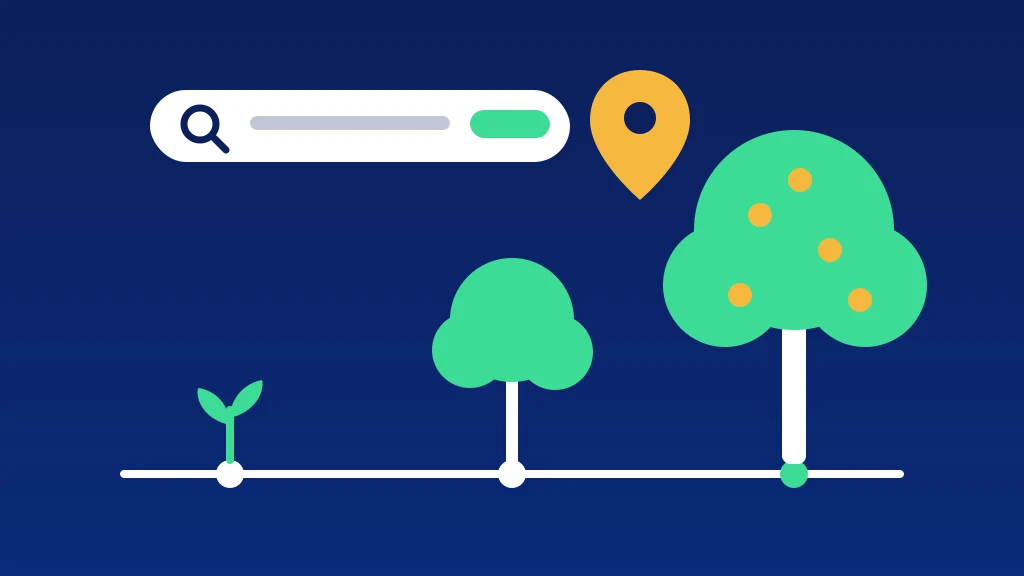
Four months to a year is a big range. It's like asking "how long until this tree gives fruit?" The honest answer depends on the soil, the sun, the water and the kind of tree. SEO is the same:
| The tree | Your website |
|---|---|
| Soil | Your site's technical health and speed. Can Google read it? |
| Seeds planted | Your pages and articles. How many, how useful, how often? |
| Water | Steady new content and updates, every week or month |
| Sun | Reviews, links and mentions from other sites that say "this business is real" |
| The kind of tree | Your keywords. A local service in one town grows faster than "best lawyer in America" |
And here's the part people forget: the trees that are already tall have been growing for years. In Ahrefs' study, 72.9% of pages in Google's top 10 were more than three years old, and the average #1 page was five years old.2 Only 1.74% of a million random new URLs made Google's top 10 within a year (6.11% when Ahrefs counted only real English content pages).2
That sounds scary. It isn't, for a local business. Most of those URLs were chasing big national keywords. You're competing with the handful of businesses in your town, not the whole internet.
A real SEO timeline: one client, eight months
Here's what happened with the client I mentioned. He runs a local practice and wanted more customers for one high-value service. We started in March.
Month 1 to 2 (March to April): the foundation. We fixed the technical issues, optimized his main pages and set up analytics. Leads from his website form started coming in.
Months 3 to 5 (May to July): planting. We published about five new pages and articles a month, all about his high-value service. During that stretch, visits from Google Search per day grew 48%.
Months 5 to 9 (July to November): the harvest starts, and the water gets cut. His website started ranking for the searches he cared about:
- His page went from not ranking to #7 to #1 on Google for his main service plus his town, the exact search his best customers type. That took about eight months.
- He showed up in Google Maps' top 3 for most of the searches we tracked for that service.
- ChatGPT recommended his business first for one or more of those searches in his area every month we checked, from May through November.
- The share of his qualified website leads asking about his high-value service went from 22% to 75%. The right people were finding him.
But in August, he moved to our smallest plan: one new piece of content a month instead of about five. Here's what happened next:
| Full plan (about 5 pieces a month) | Small plan (1 a month) | |
|---|---|---|
| Visits from Google Search per day | Grew 48% | Flat |
| Qualified form leads per month | About 5 to 6 | About 2 to 3 |
| Broad keywords for his main service | Building toward ranking | Still not in Google's top 100 |
Other things could have played a part, like a form change and the time of year. But the timing lines up closely. The pace of new content was setting the pace of results.
And the part that's on both of us
In the three months after we turned on call tracking, his website and Google Business Profile brought 57 calls and form leads from new or returning customers. Yet his office counted only about one new customer a month from the internet, and zero this month.
That gap is the real story. Some of it is follow-up: his office was calling each web lead once. Some of it is tracking: nobody was writing down which callers booked and showed. And some of it was on us: our audit found Google was only seeing about 10 of his pages. A page Google hasn't indexed can't rank, no matter how good it is.
So how long did SEO take? Rankings: about eight months for his best keyword. Leads: a few months. Customers he could count: that depends on things outside of Google, and that's what the rest of this post is about.
The 5 things that decide your SEO timeline
1. Can Google actually find your pages?
This is the fastest win most businesses never check. Google says crawling a new or changed page can take anywhere from a few days to a few weeks, and that asking for it doesn't guarantee it will show up.3 If pages aren't indexed at all, you're waiting on nothing.
What to do: Open Google Search Console, look at the Pages report and see how many of your pages are actually indexed. Submit a sitemap. For your most important new pages, use URL Inspection and click "Request indexing." Then make sure every page is linked from at least one other page on your site.
2. How fast you publish
Each useful page is another seed in the ground. Our client's data says it better than I can: about five pieces a month grew his Google traffic; one a month held it flat. That's why our SEO plans run on weeks, not months: one, two or three new pieces of content every week.
Quality still beats quantity. One genuinely helpful page beats five thin ones. But a steady pace of genuinely helpful pages beats almost everything.
3. Your Google Business Profile, reviews and listings
For local businesses, the map pack often moves before the regular results do. A complete Google Business Profile, steady reviews and accurate listings across the web are some of the quickest signals you can send. Our client's map rankings improved within a few months, well before his broad keywords did.
4. Which keywords you chase first
Ahrefs found that pages rank faster for low-volume, specific keywords than for high-volume ones.2 So go after "your service + your town" and the specific questions your customers ask before you go after the big, broad term. Win the small hills first. They bring real customers, and they build the strength to climb the big one later.
5. What happens after the phone rings
This is the one nobody puts in an SEO post. SEO brings you the lead. Your team turns it into a customer. If a web lead gets one call back, or none, SEO can look like it "isn't working" when it's actually working fine. Track every lead from first contact to paying customer, and follow up more than once.
Why our SEO is often quicker (and when it isn't)
I'll be straight with you: nobody controls Google's clock. But a few things we do are built to shorten it:
- The website is built for speed and search from day one. Our High-Performance Websites are custom-built, with pages built ahead of time so they load fast, and the titles, headings, schema and sitemap set up before launch.
- We publish every week. One to three new pieces of content a week, depending on the plan. That's 52 to 156 new pages a year.
- We check indexing by hand. We don't assume Google found a page. We look.
- We work the map pack at the same time as the website: Google Business Profile, reviews and citations.
- We check AI search, too. We ask ChatGPT, Gemini and others the questions your customers ask, and we look at who they recommend.
When isn't it quicker? A brand-new domain, a very competitive market, a site with a messy history, or a plan that publishes too little. Our client in this post hit that last one.
What's different about SEO in 2027
- AI tools are a real place people look now. In BrightLocal's 2026 survey, 45% of consumers used ChatGPT or other AI tools for local business recommendations, up from 6% the year before.4 In our experience, they reward the same things Google does: clear, accurate information about who you are, what you do and where.
- Older pages still dominate Google.2 That's not a reason to wait. It's the reason to start now. The pages you publish this year are the "old, trusted" pages of 2029.
- The basics haven't changed. Be findable, be fast, be helpful, be consistent. AI didn't change what good looks like. It just made it more obvious who's doing it.
If you're doing it yourself, here's what I would do
- Set up Google Search Console and Google Analytics, and check how many of your pages are indexed. Fix that first.
- Make a list of 20 "service + town" and question keywords your customers actually use. Ask your front desk what people ask on the phone.
- Write one genuinely helpful page a week answering one of them. Link each new page from at least one existing page.
- Request indexing for each new page in Search Console.
- Finish your Google Business Profile completely, add photos, and ask every happy customer for a review.
- Add "how did you hear about us?" to every form and phone script, with "Google," "Google Maps" and "ChatGPT / AI" as options.
- Keep a simple lead sheet: lead, source, booked, showed, bought, value.
- Judge it at 6 months and again at 12, on leads and customers, not just rankings.
Radical transparency: what we do
You knew it was coming.
We do SEO and AI search for local businesses. Plans are $1,050, $1,550 or $2,050 a month (Foundation, Growth and Authority), mostly depending on how much we publish: one, two or three new pieces of content a week. On a JDS1 High-Performance Website, 12-month plans come with our 100% ROI guarantee. Not ready for that? Our 30-Day SEO Sprint fixes the foundation and hands you a six-month plan.
Now the honest part. We can't promise you a date. Google decides when you rank, not us. We also can't answer your phone or make people show up. What we can promise is the work: weekly content, technical fixes, indexing checks, your Google Business Profile and honest reports that follow leads, not just rankings. And if your numbers aren't moving, we'll tell you why, even when part of the answer is us.
That's what happened with the client in this post. His reply, after we walked through everything: he's in, as long as we set clear checkpoints and targets together. That's fair. That's how it should work.
The bottom line
SEO takes four months to a year to show real results, and longer for the big keywords. But the clock isn't fixed. Indexing, publishing pace, your Google Business Profile, smart keyword choices and fast follow-up can all move you toward the short end of that range, while skipping them can push you past it.
It's like planting a tree. The best time was five years ago. The second best time is this week.
Your homework: log into Google Search Console and check how many of your pages Google has actually indexed. If you're not sure how, or you want someone to look for you, grab a free Online Visibility Review from the button at the top of this page. And try our free SEO ROI calculator to see what ranking could be worth for your business.
Be kind to your future business. What's your online game plan?
Footnotes
-
Google Search Central, "Do you need an SEO?", checked November 22, 2026. ↩ ↩2
-
Patrick Stox, Ahrefs, "How Long Does It Take to Rank in Google? And How Old Are Top Ranking Pages?", May 15, 2025. Based on 1 million random URLs first seen in September 2023, and the top 10 results for a random sample of US keywords. ↩ ↩2 ↩3 ↩4
-
Google Search Central, "Ask Google to recrawl your URLs", checked November 22, 2026. ↩
-
BrightLocal, "Local Consumer Review Survey 2026", February 11, 2026. Representative panel of 1,002 US adults. ↩
Pass it on
Know someone who needs this?
Send it to one business owner who’s been wrestling with this. The message is already written. It takes five seconds, and it might save them months.
Or share it on social
A caption, ready to paste
How Long Does SEO Take in 2027? Real Timelines, Real Data and How to Speed It Up Google says four months to a year. Here's what actually decides where you land in that range, with real numbers from a client, and the levers that speed it up. Worth the read 👇 https://jds1marketing.com/how-long-does-seo-take/
Tip: on LinkedIn, add one sentence of your own take above it. That’s what starts the conversation.
Keep reading
Google Business Profile Rules (October 2026): Can You Get One Without a Real Address?
A P.O. box, a UPS Store mailbox or a mail-only virtual office won't get you on Google Maps. Here's what Google actually checks, what breaking the rules costs, and what to do instead.
Local SEO Without a Google Business Profile: How to Get Found Anyway (2026)
No Google Business Profile doesn't mean no customers. Here's how to get found through your website, directories, reviews and AI answers instead.