SEO Strategy Guide for Modern Search and AI Discovery
Rankings don’t pay bills. Leads do.
Traffic looks good in a report. Rankings feel like progress. But neither guarantees revenue.
A real SEO strategy connects visibility to qualified leads and long-term growth. It is not about publishing random blogs or chasing backlinks. It is about building a system that turns search intent into predictable demand.
This guide walks you through that system step by step. SEO compounds over time, but only when it is structured correctly from the start.
If you want hands-on support, explore our SEO services. For now, let’s build the foundation.
What “SEO Strategy” Actually Means and Why Tactics Fail Alone

Many businesses confuse SEO strategy with SEO tactics.
Publishing blog posts is a tactic. Adding keywords to a page is a tactic. Buying backlinks is a tactic.
A true SEO strategy is a coordinated system that includes:
- Technical foundation
- Search intent alignment
- Content architecture
- Authority signals
- Measurement and iteration
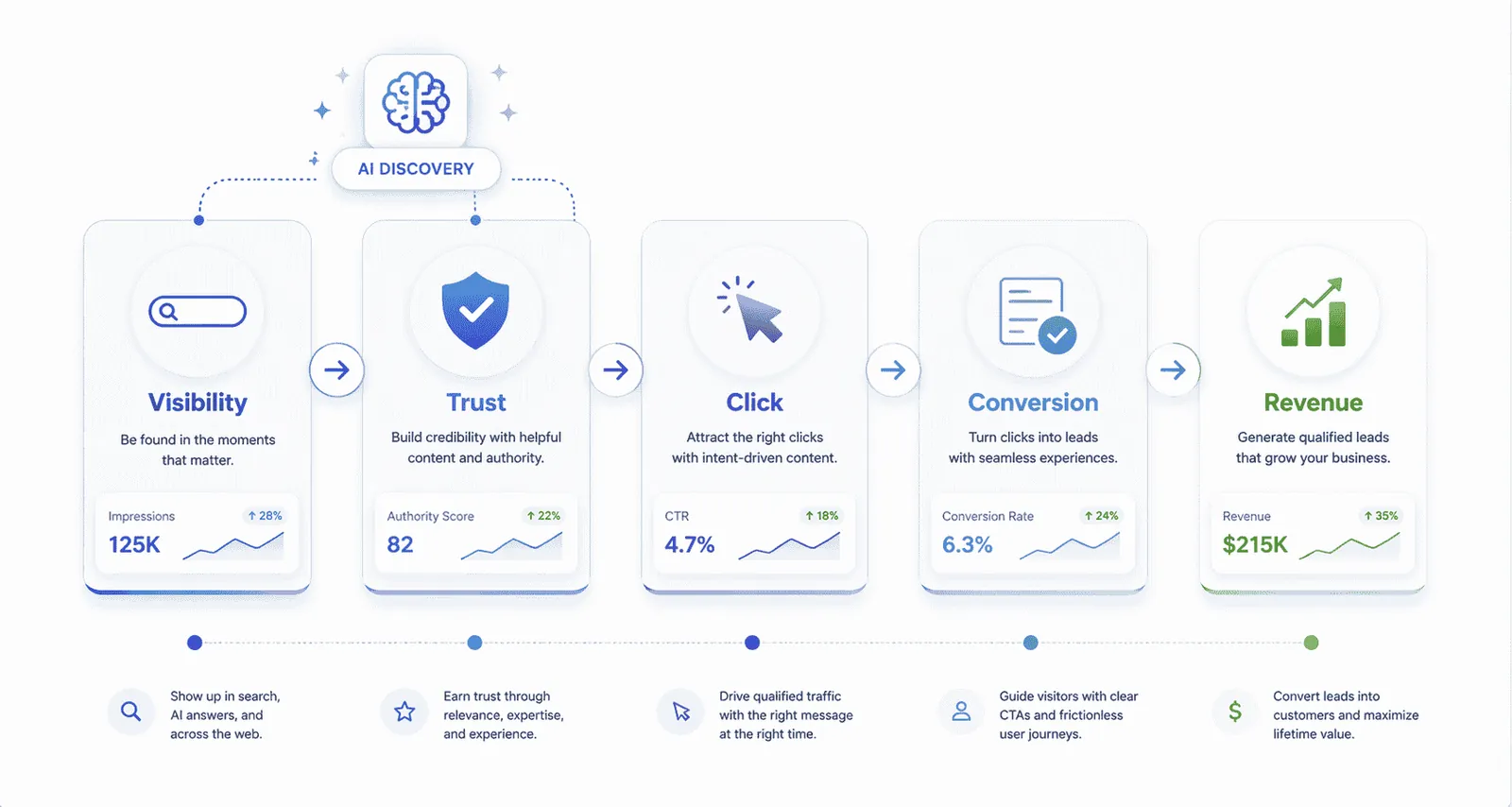
Think of it as a growth pipeline:
Visibility → Trust → Click → Conversion → Revenue
If one stage is weak, the system breaks.
For example, strong rankings without trust signals reduce clicks. Strong traffic without clear offers reduces conversions. Good leads without follow-up reduce revenue.
SEO has changed significantly in recent years. If you have not adjusted your approach, review what changed in SEO to understand the shifts shaping modern results.
Strategy aligns every piece toward revenue.
Step 1 - Start With Revenue Outcomes Not Traffic

Before writing a single page, define what a qualified lead means for your business.
For a law firm, it may be consultation requests.
For a dentist, it may be booked appointments.
For a B2B service, it may be demo requests.
Define two types of conversions:
Primary conversions
- Form submissions
- Booked calls
- Purchases
Micro-conversions
- Downloading a guide
- Watching a video
- Clicking to call
- Visiting a pricing page
If you cannot answer these five questions, pause:
- Who is the exact buyer?
- What problem are they searching to solve?
- What action should they take?
- What proof builds trust?
- How do we measure success?
Use this simple alignment framework:
Offer + Audience + Problem + Proof + CTA
When these five elements are clear, your SEO plan becomes focused. When they are vague, traffic increases but revenue does not.
Step 2 - Map Search Intent to the Customer Journey

SEO is not about keywords. It is about intent.
There are four primary intent types:
- Informational – learning or researching
- Commercial – comparing solutions
- Transactional – ready to act
- Local – looking for nearby providers
Every service should map across all four.
Example: A roofing company.
- Informational: “how long does a roof last”
- Commercial: “metal vs shingle roofing”
- Transactional: “roof replacement estimate”
- Local: “roofing contractor near me”
Each intent layer requires a different page type.
Content should guide the user forward. This is especially important as AI reshapes discovery. The modern search experience is layered and adaptive. Understanding the AI customer journey helps you design content that supports multi-touch decision paths.
Intent alignment turns rankings into opportunities.
Step 3 - Fix the Technical Foundation So Content Can Rank

Technical SEO is plumbing. If the pipes leak, pressure drops.
Search engines must:
- Crawl your pages
- Index them
- Render them properly
- Load them quickly
- Understand their structure
Start with a fix-first checklist:
- Confirm important pages are indexed
- Strengthen internal linking
- Improve Core Web Vitals and page speed
- Eliminate duplicate URLs
- Standardize templates and heading structure
Common symptoms and causes:
| | | | Symptom | Likely Cause | | Page not ranking | Not indexed or weak internal links | | Slow site | Large images or poor hosting | | Traffic drop | Technical errors or content mismatch | | Thin engagement | Weak structure or poor UX |
Before chasing backlinks, stabilize the foundation.
Step 4 - Build a Content System That Creates Topical Authority

Topical authority means becoming the most complete and trustworthy resource on a subject.
You do not win by publishing more content. You win by covering a topic better and deeper than competitors.
Your content system should include:
- Pillar pages
- Supporting guides
- Comparisons
- FAQs
- Local or service-specific pages
A simple topic cluster recipe:
- Create one strong pillar page targeting a core theme.
- Publish 6–12 supporting articles around subtopics.
- Interlink them naturally using descriptive anchors.
- Refresh content quarterly.
Avoid common traps by reviewing SEO mistakes to avoid before scaling production.
Authority is not built through volume. It is built through structure and depth.
Step 5 - Win the SERP (Snippets, PAA, and CTR)

Ranking #3 with a featured snippet can outperform ranking #1 without one.
Search engine results pages now include:
- Featured snippets
- People Also Ask (PAA)
- Local packs
- Image results
- AI overviews
To compete, structure your content intentionally.
Add:
- Clear definitions in 40–60 words
- Numbered lists
- Short answer paragraphs
- Comparison tables
- FAQ sections
If you want advanced guidance on how to win featured snippets, review the formatting strategies that increase eligibility.
You should also understand the People Also Ask strategy, since these boxes often capture early-stage interest.
Visibility is not just about position. It is about presentation.
Step 6 - Local SEO Strategy (Maps and “Near Me” Evolution)

Local SEO matters for:
- Service-area businesses
- Multi-location brands
- Appointment-based services
Maps visibility is influenced by:
- Relevance
- Distance
- Prominence
Relevance comes from optimized categories and services. Distance is geographic proximity. Prominence reflects authority and reviews.
Practical actions include:
- Optimize Google Business Profile categories
- Add services and descriptions
- Encourage consistent reviews
- Build city-specific landing pages
- Strengthen local citations
- Include local signals on-page
If you want clarity on what moves Maps rankings, focus on factors that truly influence results.
Search behavior is also evolving beyond simple “near me” phrasing. Learn why beyond near me keywords matters in modern local search.
For a structured approach, review a complete local SEO system that ties maps to leads.
Step 7 - Authority Signals (Links, Mentions, and Trust)

Authority is validation.
It comes from trusted sites referencing your business, real-world mentions, and strong brand signals.
Focus on quality over quantity. Ten relevant links beat one hundred low-quality ones.
Safe authority plays include:
- Industry partnerships
- Supplier listings
- Local organizations
- Community sponsorships
- Expert commentary
- PR coverage
Avoid shortcuts. Manipulative link schemes risk long-term damage.
Trust compounds when credibility grows naturally.
Step 8 - AI Search Readiness (Semantic Search and Citations)

Search engines now evaluate meaning, not just keywords.
AI systems look for:
- Clear definitions
- Structured headings
- Unique insights
- Strong brand signals
- Transparent author and contact information
To improve AI visibility:
- Write concise, direct explanations
- Organize content logically
- Reference credible sources
- Strengthen About and Contact pages
- Use schema where appropriate
The future of SEO includes vector-based search and semantic understanding.
To increase chances of being cited, explore strategies to earn AI citations.
Understanding ChatGPT and SEO clarifies how discovery patterns are shifting.
Above all, prioritize human-first SEO. AI rewards clarity and usefulness.
Step 9 - Measurement That Connects SEO to Leads

Do not obsess over rankings alone.
Track the lead path:
Impressions → Clicks → Engaged Sessions → Conversions → Qualified Leads
For service businesses, focus on:
- Form submissions
- Call tracking
- Conversion rate by page
- Lead quality feedback
For ecommerce:
- Revenue per organic session
- Assisted conversions
- Category-level performance
For local businesses:
- Map views
- Direction requests
- Calls
Measure what ties to revenue. Ignore vanity metrics.
Step 10 - Budget and Timeline (Set Real Expectations)

The most common question is, “How long will SEO take?”
It depends on:
- Competition
- Domain authority
- Technical baseline
- Content velocity
- Existing trust signals
In moderate markets, meaningful traction often begins within three to six months. Competitive markets take longer.
Budget decisions should reflect strategy.
You can buy short-term visibility with ads.
You build long-term equity with SEO.
If you need guidance on a realistic SEO budget, evaluate investment based on growth goals, not guesswork.
Step 11 - Google Updates and What to Fix First

Core updates recalibrate quality. They are not punishments.
If traffic drops, fix in this order:
- Indexing and technical errors
- Content quality gaps
- Intent mismatches
- Internal linking
- Trust and authority signals
Within the first 48 hours:
- Confirm indexing status
- Review affected pages
- Compare SERP changes
- Identify new competitors
For structured guidance on what to fix first after an update, follow a fix-first approach.
Stay calm. Diagnose before reacting.
Research Shortcuts So Strategy Moves Faster
Speed matters when building an SEO roadmap.
Useful search operators include:
- site:yourdomain.com
- intitle:“keyword”
- related:domain.com
- “exact phrase”
- inurl:keyword
- filetype:pdf
These help analyze indexing, competitor content, and intent alignment.
For more practical tactics, explore search operator shortcuts.
Smart research saves time and reduces guesswork.
A Simple 30–60–90 Day SEO Roadmap
First 30 Days
- Audit technical SEO
- Set up tracking
- Map search intent
- Define lead goals
Days 30–60
- Publish core content
- Improve internal linking
- Optimize on-page structure
- Strengthen conversion paths
Days 60–90
- Begin authority outreach
- Optimize for snippets
- Refresh early content
- Expand topic clusters
If you only do three things this month:
- Fix indexing issues
- Align pages to intent
- Strengthen internal linking
Execution beats overplanning.
When to Get Help And How to Choose the Right Partner
DIY SEO works in the early stages. You can optimize pages, publish content, and see movement. But as competition increases and your site grows, complexity increases too. Rankings plateau, technical issues pile up, and content slows down.
That is when strategy matters more than effort. A strong SEO partner provides a clear roadmap, transparent reporting, technical expertise, and structured content planning. Most importantly, they focus on conversions and revenue, not vanity metrics.
At JDS 1 Marketing, SEO is built as a growth system. We align technical SEO, search intent, authority, and lead tracking into one coordinated plan. If you are ready to turn rankings into measurable revenue, explore our SEO services and build a system that compounds over time.
SEO is not about chasing algorithms. It is about building durable demand.
Keep reading
Using AI for SEO Without Sounding Like Everyone Else
AI can scale your content, but without a clear strategy, it can also dilute your brand. What starts as growth can quickly turn into inconsistent messaging, weak voice, and content that sounds like…
High-Quality SEO Is AEO (Here’s Why It Matters)
Is the AEO Craze Overhyped? In short: yes. And here’s why. Search has always evolved. That’s not new. Lately, the clickbait slogan has been: “SEO is dead. You need AEO!” And I’m going to say what a…